A lead score predicts revenue only when it is built as a data model with one clear objective, such as conversion, pipeline or closed won revenue, and tested against that outcome. Score company fit, contact fit and engagement separately, then check what share of customers, revenue and booked meetings come from high-fit accounts and contacts.
Key takeaways
- A lead score is a data model. It needs one objective, such as conversion, pipeline generation or closed won revenue, and a test against it.
- Score company fit, contact fit and engagement separately. Fit says who to prioritize and engagement says when; one combined score hides the difference.
- Test feedback instead of debating it. Duplicate the model, apply the suggested change and compare how well each version predicts the outcome.
- One client went from 44% to 84%. After rebuilding fit and engagement scoring, the share of revenue from accounts classified as high fit rose from 44% to 84% in three months, and MQL volume increased.
Most companies have a lead score. Far fewer can tell you whether it actually works.
I’ve seen plenty of models with detailed scoring rules, MQL thresholds and automated routing into sales. But ask what the model is supposed to predict, or whether anyone has tested it against revenue, and the answer is often less clear.
I recently sat down with Guilherme Larroyd (Gui), one of our GTM specialists at Lean Layer, for a Deep Dive on lead scoring. Gui has built and audited scoring models across a number of our clients, and we talked through why so many fail to deliver what marketing and sales actually need.
Your lead score is a data model. Treat it like one.
A lead score should be built around a clear objective, whether that’s conversion, pipeline generation or closed won revenue. Without one, you’re effectively assigning points to leads and hoping those numbers mean something.
This is also where a lot of the friction between marketing and sales comes from. Marketing thinks it’s delivering qualified leads. Sales disagrees. The usual response is another alignment meeting, but neither team has the data to establish who’s right.
Rather than debating feedback, test it. Duplicate your scoring model, apply the changes being suggested, and compare how well each version predicts your chosen outcome. The goal isn’t to eliminate human judgment. It’s to use data to validate it.
Five common mistakes we see
- Fit is binary rather than a scale. A company with 149 employees falls outside your ICP, but at 150 it’s suddenly qualified. Not every company within your ICP has the same likelihood of buying, generating revenue or retaining. Your model should reflect those differences.
- Fit and engagement are combined into one score. Fit tells you who to prioritize. Engagement tells you when. A great-fit account with little engagement needs a different approach from a poor-fit account requesting a demo. Combining the two makes it difficult to distinguish between them.
- Company fit and contact fit aren’t separated. Particularly in B2B, a perfect-fit account doesn’t mean every contact is worth pursuing. The person downloading white papers may have no influence over the buying decision. You need to score both independently.
- Engagement is capped or decays too aggressively. If attending one webinar earns the same points as attending four, you’re losing useful information. Similarly, a demo request shouldn’t go from highly relevant to worthless overnight. Activity weights and decay rules should reflect actual buying behavior.
- The model has never been tested against revenue. You can follow every lead scoring best practice and still end up with a model that doesn’t predict how your business makes money. This is the biggest issue we see.
How we approach lead scoring
At Lean Layer, we typically separate scoring into three components:
- Company fit. Which accounts look most like the customers that generate revenue? Use your historical opportunity and customer data to identify the characteristics associated with successful deals.
- Contact fit. Who within those accounts should sales prioritize? Look at the roles and characteristics of contacts involved in successful opportunities.
- Engagement. Is there evidence of buying interest right now? Weight activities based on their relationship to conversion, with recent signals generally carrying more value than older ones.
Each component answers a different question, and each should be validated against actual outcomes.
One pattern Gui sees regularly is that engagement accounts for almost the entire lead score, while company and contact fit have little influence over MQL qualification.
Often that’s because marketing is reluctant to introduce fit thresholds that might reduce MQL volume. But when sales repeatedly receives leads that have little chance of converting, confidence drops and follow-up suffers.
The answer isn’t necessarily fewer MQLs. It’s more MQLs from the right accounts and contacts. That means tightening fit criteria while also improving how you identify and generate meaningful engagement within your target audience.
What this looked like for one client
Gui shared an example of a client whose lead scoring model was heavily weighted toward engagement, with capped activity scores and no meaningful fit requirements for MQLs.
The company wanted more MQLs and better MQLs, but only 44% of revenue came from accounts the existing model classified as high fit. More than half of revenue was coming from accounts supposedly outside their best-fit population.
We rebuilt the company and contact fit scores, adjusted engagement scoring and helped marketing focus on the audiences and behaviors more closely associated with revenue.
Three months later, 84% of revenue was classified as coming from high-fit accounts, MQL volume had increased, and the client had reached its target. The change from 44% to 84% doesn’t necessarily mean the scoring model generated incremental revenue. It means the new model was much better at identifying the accounts responsible for it, which is exactly what a good scoring model should do.
Three numbers worth checking
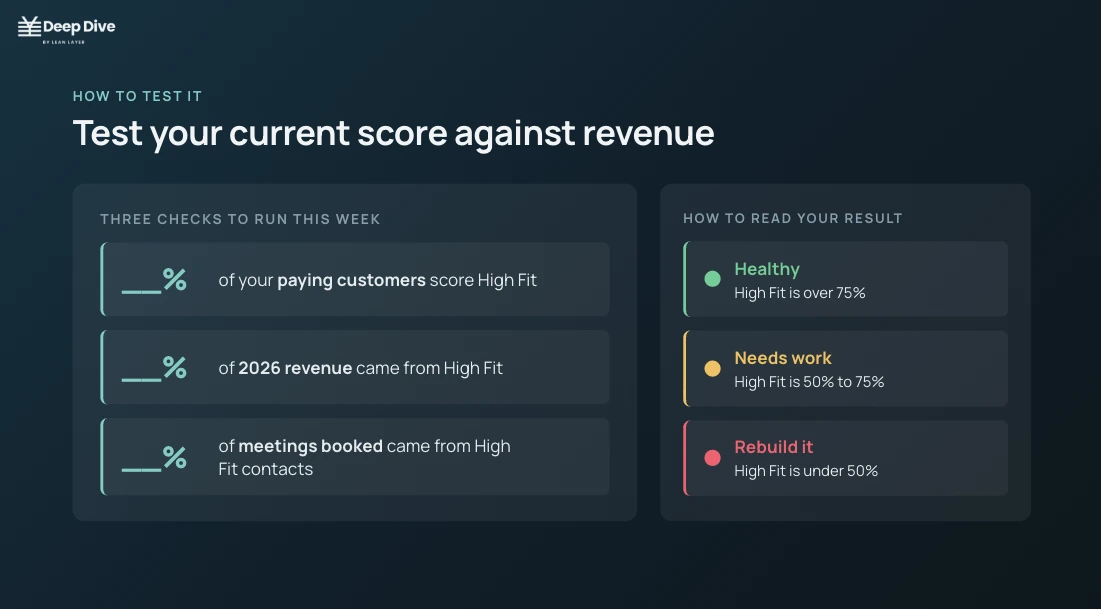
If you have an existing lead score, I’d start with three questions:
- What percentage of paying customers are classified as high fit?
- What percentage of revenue comes from high-fit accounts?
- What percentage of booked meetings come from high-fit contacts?
If you can’t answer these questions, or the results don’t support your scoring logic, you have a good starting point for improving the model.
Lead scoring should be more than a mechanism for deciding when someone becomes an MQL. It should help you continuously refine your ICP, focus sales and marketing effort, and understand which accounts and contacts are most likely to generate revenue.
We cover the scoring framework, validation approach and full client example in our latest Deep Dive session on lead scoring.
Frequently asked questions
What should a lead score predict?
A lead score should predict one outcome you choose up front, such as conversion, pipeline generation or closed won revenue. Without a clear objective, points are assigned to leads with no way of knowing whether they mean anything, and marketing and sales have no shared data to settle whether leads are qualified.
Should fit and engagement be combined into one lead score?
No. Fit tells you which accounts and contacts to prioritize, and engagement tells you when to act. A great-fit account with little engagement needs a different approach from a poor-fit account requesting a demo, and a single combined score makes the two hard to tell apart. Company fit and contact fit should also be scored separately.
How do you test a lead scoring model?
Duplicate the scoring model, apply the change being suggested, and compare how well each version predicts the outcome the score is built for, such as closed won revenue. Testing replaces debate between marketing and sales with evidence, and every component of the score, company fit, contact fit and engagement, should be validated against actual outcomes.
What numbers show whether a lead score works?
Three are a good start: the percentage of paying customers classified as high fit, the percentage of revenue that comes from high-fit accounts, and the percentage of booked meetings that come from high-fit contacts. If these cannot be answered, or the results do not support the scoring logic, the model needs work.