AI agents can run a sales playbook once three things are in place: a defined sales process with clear stage entry and exit criteria, CRM data accurate enough to forecast from, and a playbook built from what winning reps actually do. Agents then act on every deal touch point, and managers coach reps against the same playbook.
Key takeaways
- The sales process is the foundation. Stages and their entry and exit criteria make the CRM consistent enough to forecast from.
- Agents are only as good as the CRM data under them. Stale deals and loose stage definitions produce a forecast nobody trusts, and an agent working from that data repeats the error on every deal.
- AI turns the playbook from a static document into a living one. It can re-read won and lost deals as they close, so the playbook keeps up with a market that changes inside two quarters.
- A written playbook is a coaching tool. Once good is defined, a manager can see which reps run it and coach to the gap rather than to opinion.
The order matters
Today’s Deep Dive with Kim Hacker and Daniel Zarick of Arrows was about turning what your best reps know into a sales playbook that AI agents can run. We kept coming back to sequence. Agents only work when the layers underneath them hold:
- A defined sales process. Stages, with entry and exit criteria everyone uses.
- CRM data you can trust. Deals in the right stage, properties filled in, nothing stale.
- A playbook built from what works. What your best reps actually do, written down.
- Agents that run it. Doing the baseline work on every deal so reps spend their time on judgment.
Start with the sales process
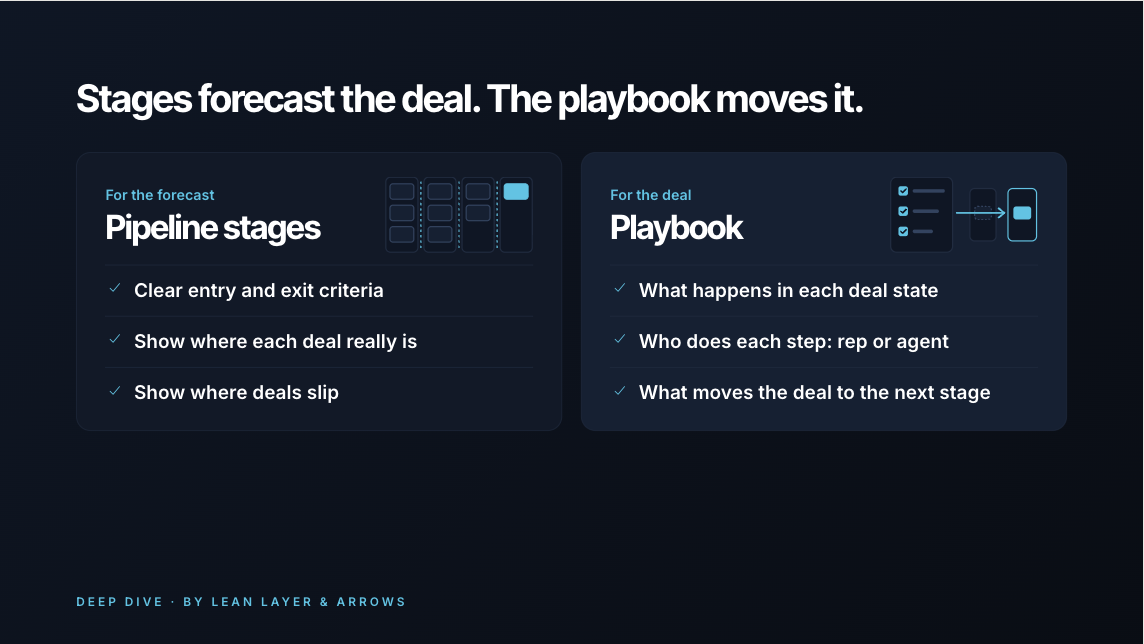
The sales process is your stages and their criteria, and it gives you a CRM you can forecast from. The playbook is what a rep does at each stage and how. Most companies have a process of some kind. Very few have a playbook, and one written on a weak process documents stages nobody agrees on.
Then make the CRM data true
AI is only as good as the data behind it. If the pipeline is full of deals that should be closed, you cannot trust the forecast, and an agent working from it repeats the error on every deal. In my experience, teams put off the cleanup because it shows a bigger gap than the one they report today. That gap was already there.
For a HubSpot client whose revenue reports did not match their financial records, we rebuilt the pipeline stages and automated deal recycling. For a client whose forecast collapsed after a market shift, we redefined their qualified stage on historical win rates, and they closed the next quarter within 5% of forecast. Neither was a one-off fix. A data foundation has to be maintained.
From a static document to a living playbook
A playbook used to be written for sales kickoff and then left in a drawer. AI has changed that. It can read your deals, calls and emails and keep the playbook current with what is actually winning.
We are in a world right now where we can have a playbook that is analyzing your deals, analyzing what’s actually happening.
Kim Hacker, COO, Arrows
That matters because the market moves fast. Even if you write your playbook down this quarter, I bet it looks different in two quarters.
A playbook is a coaching tool
Once good is written down, a manager can see which reps run it and coach to the gap instead of to a feeling. It is the same principle behind grading reps on effort, impact and outcomes. For one CRO we built the rep ranking from what the most effective reps were already doing, and found speed to lead correlated with a higher win rate. Building the playbook from your data also shows a sales leader what reps really do on calls they never hear, which is what you need going into sales kickoff.
Where agents and partners come in
With the foundation in place, the playbook gets two tracks: what the rep does at each point, and what an agent does, with the context it needs such as your ICP, pricing, objections and what risk looks like. Agents add capacity rather than more selling. They handle the baseline work so reps spend their time on judgment.
Partners like Arrows make that efficient. Their free playbook skill at skills.arrows.to drafted 18 plays from a demo team’s deals in Claude, and Arrows runs the playbook proactively across a team. Lean Layer builds the process, the data foundation and custom agents underneath it. Watch the full recording of Tribal Knowledge to a Sales Playbook.
Reach out if you have a question!
Kim
Frequently asked questions
What is the difference between a sales process and a sales playbook?
A sales process is the set of pipeline stages and the entry and exit criteria between them. It keeps the CRM consistent enough to forecast from and to read risk across deals. A sales playbook sits on top of it and says what a rep should do at each stage, how to do it, and why, so that every rep can run deals the way the best ones do.
Why does CRM data quality matter for AI agents?
An agent decides what to do on a deal from the data in the CRM. If deals sit in the wrong stage, key properties are empty or stale deals are never closed, the agent acts on a false picture and repeats the mistake across every deal it touches. Auditing the CRM, fixing stage definitions and keeping the pipeline clean has to come before agents run a playbook.
How often should a sales playbook be updated?
Continuously, or at least every quarter. Buyers, competitors and pricing can all change within two quarters, so a playbook written at sales kickoff and left alone is usually out of date by mid-year. An AI-maintained playbook can re-read won and lost deals as they close and suggest changes as patterns shift.
How does a sales playbook help coach reps?
A playbook defines what good looks like at each stage of a deal. With that written down, a manager can see which reps follow it and where their deals drift, and coach to that specific gap. Built from the habits of the most effective reps, it turns their tribal knowledge into a standard the rest of the team can be measured and coached against.
What makes a sales playbook agent ready?
An agent-ready playbook says what the rep does and what the agent does at each point in a deal, and why each step matters. It includes the business context an agent needs, such as the ICP, pricing, objections and proof, plus definitions of what an on-track deal and a risky deal look like, for example an agreement sent with no economic buyer involved.